
Dissonant Legacies: Engaging with Difficult University Heritage
Dissonant Heritage
Item set
- Title
- Dissonant Heritage
Items
19 items
19 items
-
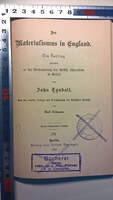
Alfred Weiland’s books
Bücherei beim Höh. SS- u. Pol. Führer f. d. Ostland (Library at the Higher SS- and Police Commander for the Eastern Land) -
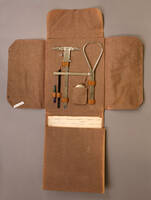
Anthropological measuring instruments and photographic plates of human teeth
Anthropological measuring instruments were used to measure the human skull and various body parts. The set of items includes a craniometer, a tool used for measuring the skull, as well as equipment used in other measurements. The set also contains forms where the details of the individual being studied were recorded. Skull measurement, or craniometry, was one of the methods of physical anthropology. Researchers classified human groups based on these physical characteristics, such as the proportions of their skulls. Physical anthropology was associated with the study of races, which was prevalent in science, particularly in the 19th and early 20th centuries. The research aimed, among other things, to demonstrate that some races were superior or purer than others. The photographic plates originate from the Department of Anatomy at the University of Helsinki. They may be related to Yrjö Kajava's anthropological research on the Sámi people´s teeth conducted in 1912. Kajava was a professor of anatomy at the University of Helsinki from 1921 to 1929. The teeth may have been photographed from Sámi skulls. The skulls belonged to a collection preserved in the Department of Anatomy, which included human skulls and bones. Human skulls were acquired for the collection through unethical means, such as exhuming graves in Sámi cemeteries. In 1995, the university returned some of the Sámi bones to Inari for burial, and the rest in 2001 to be kept at the Sámi Museum Siida. These remains have also been buried in 2022. Before World War II, the Sámi people were studied in the Nordic countries using methods of physical anthropology. The aim was to investigate, among other things, the mixing of races. The Sámi are the only recognized indigenous people in the European Union. Despite the security of the Nordic welfare state, they have been in a subordinate and socioeconomically disadvantaged position compared to other populations. -
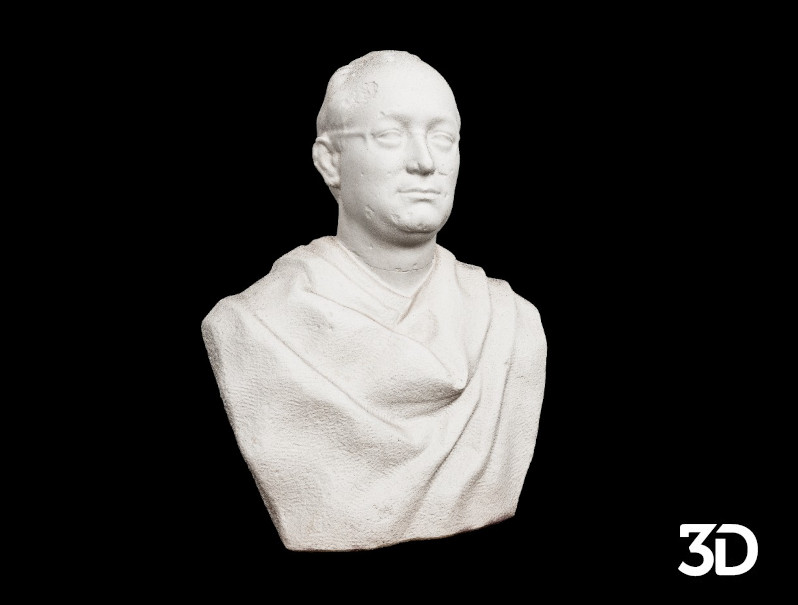
Bust of José Ibañez Martín
Bust in stone of José Ibañez Martín -
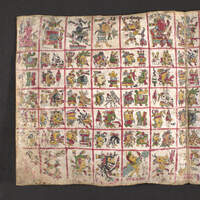
Codex Cospi
The Codex Cospi, housed in the University of Bologna Library, is an invaluable resource for understanding the indigenous Mesoamerican culture. The University has undertaken numerous projects aimed at study and dissemination, including the complete digitization of the manuscript, which is now publicly accessible on the library's website. The images displayed here are taken from this digital copy. -
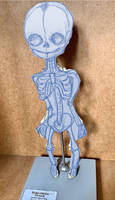
Foetus skeleton
The "foetus" skeleton - overlaid with an illustration. The so-called "foetus skeleton" was bought by the Freie Universität Berlin from the company SOMSO in the 1970s. But at what, or rather at whose cost? -
-

Laura Bassi
The image above is a portrait of Laura Caterina Bassi Veratti (1711-1778), the first woman in Bologna to earn a degree in 1732 and the first female university lecturer, shown delivering her inaugural public lesson. A copy of the portrait is displayed at the European Museum of Students (MEUS) of the University of Bologna, while the original is preserved at the State Archives of Bologna (Insigna degli Anziani, vol. XIII, Novembre-Dicembre 1732, c. 98a). -
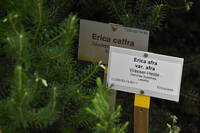
Plant labels at the Botanical Garden and Botanical Museum
In 2024, the International Botanical Congress in Madrid decided that the species epithets ‘caf(f)ra’, ‘caf(f)rorum’ and ‘caf(f)rum’, which derive from the racist slur ‘kaffir’, shall be replaced by ‘afra’, 'afrorum' and ‘afrum’ as neutral terms for ‘African’. As a result, in February 2025 the Botanic Garden Berlin replaced the first plant labels in its greenhouses. -
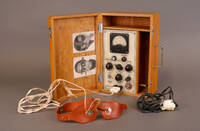
Portable electronic device for treating sleep disorders
The Elektron electrical sleep device manufactured in the Soviet Union was intended for the treatment of sleep disorders. A representative of the Finnish government received the device from the Soviet Union, presumably during an official state visit in the 1950s. The device was subsequently transferred to the psychiatric clinic of the University of Helsinki. A psychiatry professor who worked at the clinic recounts in his memoirs that the device was tested in the 1960s, but only a placebo effect was observed in the patients. The device is an example of how the phenomenon of "Finlandization" manifested in academic contexts. After World War II, Finland had to submit to the influence of the Soviet Union in its foreign and domestic policies. Finland and the Soviet Union had extensive bilateral cooperation, which Finland maintained in order to keep good relations with the totalitarian neighboring country. As a result of this cooperation, the University of Helsinki received scientific equipment, some of which was useful and practical, while some ended up gathering dust in the university's storages. -
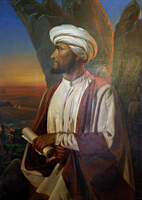
Portrait of Professor Georg August Wallin
Georg August Wallin was a Finnish explorer, Arabist, and professor of Oriental literature at the Imperial Alexander University, now known as the University of Helsinki. Wallin undertook three long research expeditions to the Arabian Peninsula in the 1840s and 1850s. Wallin prepared for his journeys meticulously by studying Arabic and basic medical skills, as well as familiarizing himself with the customs of the people and Islam in Cairo. During his travels in places such as Syria and Mesopotamia, he disguised himself as a Bedouin and pilgrim, which allowed him to gain access to the lives of those he was studying. His travel accounts were published in the journal of the Royal Geographical Society of England, and he was regarded as a significant researcher in his field. The posthumous portrait of Wallin was prominently displayed in the representative spaces of the University of Helsinki for a long time. Following the building's renovation in 2021, it was decided to leave the artwork in the museum's collection spaces due to feedback received by the university. In the portrait, Wallin is depicted wearing traditional Arabic attire, which can be seen as cultural appropriation. The Office of the Ombudsman for Equality in Finland suggested transferring the artwork from the representative space to a more museum-like setting, where it would be easier to present the background information of the piece. So far, the Helsinki University Museum Flame has not had the opportunity to do so. -

Posters after the work of the anthropologist Rudolf Martin
The University of Bologna holds a complete collection of 24 posters created by the Swiss anthropologist Rudolf Martin, published in 1903, depicting various "racial types" from around the world. Among those on display are representations of the following groups: Eskimos from Alaska, Batak from Sumatra, and Karen from Myanmar. For decades, these materials were used in teaching and research to support the racist paradigms of that era. However, today the collection has been completely recontextualized: new information panels clarify that these items now have "exclusively historical interest" and "represent a view of human variability that has been absolutely and definitively banned by modern anthropology." -
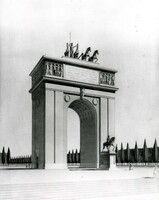
Project for the Construction of the Triumphal Arch of the University
Watercolour drawing part of the construction project for the The Arch of Victory erected between 1956 and 1958. -
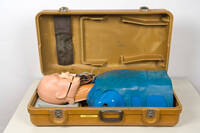
Resuscitation manikin
Resuscitation manikin: didactic object -
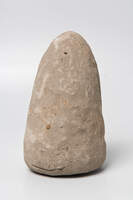
Silent ethnographic objects
Objects collected in Central Africa in unknown conditions. -
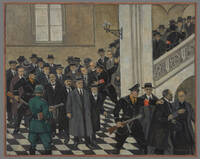
The Arrest of Jagiellonian University Professors on November 6, 1939
Sonderaktion Krakau refers to the Nazi operation carried out on 6 November 1939, when the German authorities arrested 183 professors and academic staff from the Jagiellonian University and other Kraków institutions. The scholars were deported to concentration camps, mainly Sachsenhausen and Dachau, where several of them died. -
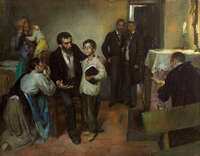
The Family of the Anarchist on the Day of the Execution
Oil painting on cavas. Interior scene of a room, with several people, among them the prisioner and his child. -
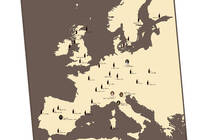
The first women graduates from European Universities
This map, displayed in the gender issues section of the European Museum of Students (MEUS) of the University of Bologna, documents the chronology of the first female university degrees in Europe. The visualization reveals a long and uneven historical process, with examples scattered across different countries from the late seventeenth century to the early twentieth century. -
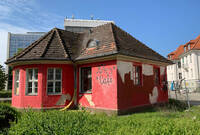
The former premises of Kaiser Wilhelm Institute for Anthropology, Human Heredity and Eugenics
The small, red-painted building with a hipped roof in Berlin-Dahlem housed the leftist students’ space known as the “Rotes Café” (Red Café) from the late 1990s until it was closed for safety reasons in 2017. It was originally constructed in 1926/27 as an animal stable for the Kaiser Wilhelm Institute for Anthropology, Human Heredity, and Eugenics—an institute that later became closely intertwined with the National Socialist regime’s policies of persecution and extermination. The stable also contained a dissection room, where geneticists conducted experiments to investigate the principles of heredity. -

The memory of anti-Semitic persecution
In 1938, the Fascist regime adopted state antisemitism through the so called “racial laws”, which imposed numerous discriminations, including prohibiting Jews from teaching at universities or enrolling as students. The university's direct involvement in implementing these measures is evident in the letter dated December 7, 1938, from the rectorate to Professor Gustavo Del Vecchio, who held the chair of Corporative Economy, informing him of his forced resignation for racial reasons. The University of Bologna was among the Italian institutions most severely affected by the antisemitic laws, with 49 academic staff members forced to resign.